January 13, 2026
Report from Young Professional Grant Recipients on ICOM Dubai 2025
A Cultural Journey Through the ICOM General Conference in Dubai
Mohammed Elseidy[1]
Attending the ICOM General Conference in Dubai in 2025 was a truly inspiring experience. It was my first time joining this major global event with the support of the Young Professional Grant, and it opened my eyes to how museums can shape societies. The theme, “The Future of Museums in Rapidly Changing Societies,” felt very real and meaningful. Dubai made history as the first city in our region to host the conference since ICOM was founded in 1946, and this gave the gathering special energy and pride. The atmosphere was welcoming and full of exchange, where museum professionals from around the world came together to discuss heritage, culture, and the future of museums.
As an Egyptian participant and a board member of ICOM Egypt, I felt especially proud to see Egypt represented with the largest Arab delegation of around sixty professionals. Our delegation was led by Dr. Osama Abdel Wareth, the President of ICOM Egypt, who emphasized that museums are bridges between civilizations and tools of soft power. This message deeply resonated with me. Egypt’s national projects were strongly represented through presentations on the Grand Egyptian Museum and the National Museum of Egyptian Civilization. These examples showed how our country is combining ancient history with modern innovation, positioning museums as cultural destinations that engage visitors and tell stories in new ways.
Many Egyptian colleagues presented research papers, participated in discussions, and built connections with international experts. This helped strengthen Egypt’s presence and opened doors for future cooperation. I personally benefited from meeting museum professionals from across the Arab world, Europe, Asia, and Latin America, learning how different countries are rethinking museum roles, education programs, and technology use.
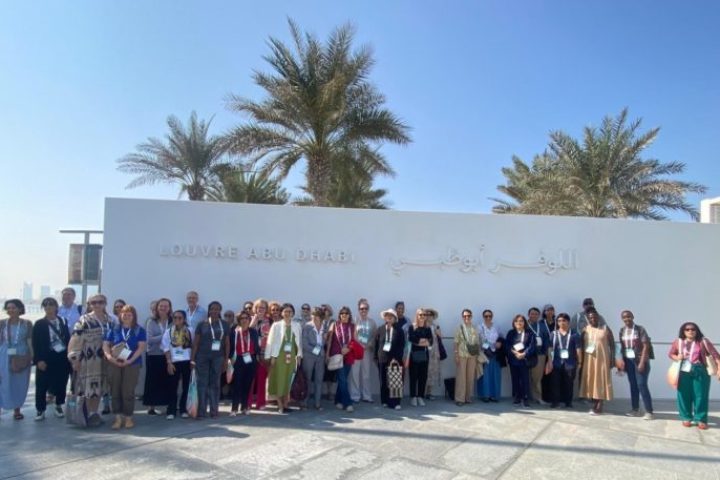
One highlight of the conference was the organized visit to the Louvre Abu Dhabi and the museums in Sharjah. The Louvre Abu Dhabi provided an amazing example of how art and history can be displayed to tell a shared human story. Its universal collection philosophy showed how museums can move beyond national narratives to create global conversations. The building itself, with its iconic design, demonstrated how architecture can complement storytelling and reflect cultural identity. Sharjah offered a different but equally rich experience. The museums there focused strongly on local heritage, community engagement, and urban renewal. This reflected how cities can grow cultural sectors not only for tourism but also for education and social connection.
These visits confirmed my belief that the Arab world is entering a museum renaissance. Each country has its own style, yet all are investing in museums as spaces for learning, dialogue, and creativity. The conference helped me understand that museums are not just places to display objects; they are living platforms where people meet, learn, and build cultural understanding. I returned home with clear goals: to apply international best practices in interpretation and conservation, to support digital documentation of intangible heritage, to design community-focused educational initiatives, and to strengthen professional links to support regional projects.
I am deeply grateful for the Young Professional Grant that allowed me to participate in this conference. It was more than a professional event; it was a turning point in how I view my work. I came back feeling motivated and responsible to contribute to the development of museums in Egypt and the region. This experience confirmed that investing in young professionals is truly an investment in the future of our cultural heritage.
[1] ICOM Egypt Board Member and Senior Cultural Heritage Specialist, Supreme Council of Antiquities, Egypt
Report on attending ICOM Dubai 2025
Submitted by Henrielle Louise Omolida (ICOM Philippines)
ICOM Dubai 2025 with a theme “The Future of Museums in Rapidly Changing Communities” was successfully organized on 11-17 November 2025 at the Dubai World Trade Center and various offsite venues across the United Arab Emirates (UAE). The conference offered a wide range of programs including mentorship sessions, lightning talks, keynote addresses, workshops, and networking events organized in parallel sessions that allowed more than 4,500 participants to tailor their experience to their individual areas of interests. Topics on intangible heritage, youth power, and the rise of new technologies were presented during the scientific days. Notably, the growing impact of artificial intelligence on museum work emerged as a recurring topic of discussion across different sessions.
In the joint symposium of ICOFOM, COMCOL, and ICTOP on ‘Imagining the Next Generation of Museum Professionals: Bridging Gaps, Breaking Barriers,’ these topics were explored through the lens of post-digital museology — a concept when digital becomes the normative state in the museum — emphasizing ethical thinking, creativity, and strategy as integral components of post-digital museum practice. This critical approach was complemented by the case studies on mounting artefacts, stewardship of sacred and ritual objects, and community engagement to safeguard cultural heritage. The importance of shared custodianship and collaborative museum practices was also echoed across other plenary and International Committee (IC) sessions. .
ICOM Dubai 2025 also served as a platform to experience the rich cultural heritage of UAE through thematic programs and offsite activities. For instance, the art workshop facilitated by young Emirati artist Abdullah Lufti introduced delegates to iconic architectures of Dubai through a set-by-step illustration activity. This session demonstrated how creativity, particularly a neurodiverse artist’s perspective, can enrich cultural learning while expanding our understanding of accessibility and inclusive program design. Meanwhile, the IC Day of ICTOP at Louvre Abu Dhabi showcased academic and professional development programs across UAE that contribute to capacity building for current and future museum practitioners, artists, and creatives in the region. These programs provide insight on how the region prepares for and supports its rapidly developing cultural landscape.
Finally, the General Assembly provided an opportunity to observe formal proceedings such as committee reports and the announcement of new officers and award recipients. The newly elected ICTOP board members were also introduced during its IC Day. As a young museum professional, witnessing these sessions gave me a deeper appreciation for the extensive behind-the-scenes work that sustains ICOM’s global network.
Participating in ICOM Dubai 2025 was an invaluable experience that broadened my understanding of international museum practice and its future direction. I am grateful to both ICOM ICTOP and my institution for supporting my attendance. Equally meaningful was the generosity of the speakers and attendees who openly shared their expertise and experiences. Their insights motivate me not only to apply what I have learned, but also to further engage in critical discourse on the responsible use of technology and the advancement of collaborative museum practices.